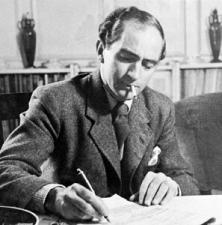
Christopher Fry, once of the last modern playwrights to find success writing entirely in verse, died June 30 in Chichester, England, the New York Times reported.
Mr. Fry was 97 at the time of his death, and his moment in the sun had long since passed. But for a roughly a decade following World War II, he was one of Britain's leading playwrights, applauded for the beauty and probing intelligence of his sincere-minded plays, of which The Lady's Not for Burning is the most famous and enduring. In 1950, he saw three of his plays hold different stages in London, as well as an adaptation of Anouilh's Ring Round the Moon, presented by Peter Brook.
Along with T.S. Eliot, Fry represented a small movement to revive verse drama in the modern theatre; indeed, Eliot was the younger man's mentor and inspiration. One of his earliest play, Boy With a Cart, was influenced by Eliot's Murder in the Cathedral.
That play was about a ninth-century shepherd who founded a church, according to the Times. Other Fry plays had similarly spiritual, religious or humanistic topics. The Lady's Not for Burning was about a woman who is accused of witchcraft because of the scientific experiments she conducts. Venus Observed tells of a Duke who faces up to his detachment from life. The Dark Is Light Enough concerns a Countess who finds herself in the middle of two armies.
Critic Harold Clurman said "The epigraph for Fry's art is `Shall we not suffer as wittily as we can?'...He wears his rue with a difference—of bright phrases, happy conceits and a rich heritage."
Picked by YouKillEmWeChillEm.